Here's how the Observer books pages saw the digital debate I took part in last week. Wish I'd been there, it sounds a touch more exciting than the one I took part in.
Tempers were running high at the V&A last week, when a debate on the future of books in the digital age turned into a very public scrap between Daniel Stacey, editor of Bad Idea, and Times Online books editor Michael Moran. A surprising addition to the Luddite corner, Moran claimed he didn't like e-book readers because his children would spill Ribena on them and, worse, you can't display them in your house like books. Striking a blow for the technophiles, Stacey swiftly countered that 'stacking books on shelves is a gauche way of displaying cultural credentials'. A full-blown duel was prevented by the quick thinking of literary agent Charlie Campbell, who poured oil on troubled waters by donating wine strictly reserved for the speaker's table to the het-up assembly at large.
Poured wine on troubled waters, surely?
Monday, 9 June 2008


Thursday, 5 June 2008
‘A Granta for the MySpace Generation’ (Observer)
From Gladstone and Disraeli to the Victoria and Albert  Museum. Last Friday, the latest of the museum’s Friday Lates events took place, hosted by literary magazine Bad Idea (and whose anthology we have just published). As well as the launch for the book, there were numerous happenings dotted around the museum organised by the editors, as well as a Question Time style panel which I found myself sat on. Alongside the extremely nice Mil Millington, Times Online Journalist Michael Moran and agent Charlie Campbell, I discussed and answered questions on publishing, the internet, and all things digital. Despite the breakneck enthusiasm for electronic books, my sense was that both the panel and the audience seemed more reserved about the whole thing. This was echoed in a recent Zogby poll that found that only 3% of Americans had a e-book reader, and only a further 4% were considering buying one in the near future.
 Museum. Last Friday, the latest of the museum’s Friday Lates events took place, hosted by literary magazine Bad Idea (and whose anthology we have just published). As well as the launch for the book, there were numerous happenings dotted around the museum organised by the editors, as well as a Question Time style panel which I found myself sat on. Alongside the extremely nice Mil Millington, Times Online Journalist Michael Moran and agent Charlie Campbell, I discussed and answered questions on publishing, the internet, and all things digital. Despite the breakneck enthusiasm for electronic books, my sense was that both the panel and the audience seemed more reserved about the whole thing. This was echoed in a recent Zogby poll that found that only 3% of Americans had a e-book reader, and only a further 4% were considering buying one in the near future.
  The Bad Idea editors Jack Roberts and Daniel Stacey are the latest in a long line of that most important of literary institutions: the champions of new writing. These champions are to be cherished, and it felt fitting to me that among the many wonderful writers in the anthology, was another long standing champion, Nick Royle. Ten years ago this month, I was lucky enough to have my first ever piece of writing published in a similar anthology edited by Nick. So it was nice for me not only to be able to repay the favour, but to oversee the passing of the baton to the next generation of literary champions.
Some things don’t change

In the past few weeks, the papers have been full of Cherie Blair, Lord Levy and John Prescott washing their tawdry linen in public – sorry, promoting their heavyweight political memoirs. As books go, they’re all something of a disappointment. One thinks of previous political memoirs – Denis Healey, Tony Benn, Barbara Castle – and how well-written, revelatory and ick-free the genre used to be. As a way of raking in the cash, though, they continue an extremely time-worn tradition. I’ve just finished Richard Aldous’s The Lion and the Unicorn, a fascinating dual biography of Gladstone and Disraeli (I know that sounds like the worst kind of wanky Summer Reading pull-outs in the Observer, but bear with me) and when Disraeli leaves office for the last time, he is offered the then megabucks sum of £10,000 to write a novel. Considering how this was more than the heavyweight novelists were on at the time (Dickens and George Eliot were the biggest earners on £9000 a book), and you can see that in 150 years, very little has changed.
Tuesday, 22 April 2008
Are books getting longer?


One of the books I’ve been really enjoying over the last couple of months (the ones I’ve commissioned aside, of course) is Mark Penn’s fascinating Microtrends. Penn is an American pollster famous for coining the phrase ‘soccer mums’, a small but influential group of voters who could swing elections. In Microtrends, he describes dozens of these other groups that aren’t large enough to make headlines, but still plenty big enough to change things. One movement he notes in culture is that of the rise of the long attention span – that despite culture supposedly dumbing down, there are many of watching longer films, loving The Sopranos and The Wire, and not being put off by doorstep books. There’s a graph in the book, which shows how the length of the average book has risen over the past ten years, from just under 400 pages in 1995, to just under 500 pages in 2005.
That might be a sign that people want stuff in more depth. But my first reaction as a publisher was to think, whatever happened to the art of editing?
Friday, 18 April 2008
Fair Enough

Monday to Wednesday this week has seen publishing taking part in its annual gathering to moan about the London Book Fair. I think it’s compulsory to go on about how much you hate it, even though secretly everyone quite likes a couple of days out of the office swanning around as though they’re dead important. The days of the big fair books felt a long time ago, with most of the major announcements being books that had been bought months back and the rights people seeing more action than editors. The best bits, as always, were not the appointments themselves, but the people you bump into in the corridor. On Tuesday night, an impromptu gathering in a nearby pub swelled into what felt like half of publishing by the time I wended my way. I got more out of those couple of pints than the rest of the fair put together.
Tuesday, 8 April 2008
And the Winners Are...

Ever so slightly belatedly, here are the results of the Bad Idea/ Portico writing competiton. The winner was Emma Hooper, with the following writers shortlisted: Susan Jackman, Caroline Moran, Tom Williams and Benjamin Wood. If you ever want to know what it feels like being an alcoholic, try queuing up with competition prizes of five bottles of whisky plus a sandwich for your lunch! There was a whole range of quality entered, but what I particularly enjoyed was the passion that people showed for the process of writing itself. I was disappointed, perhaps a little bit, that every single one of the entries were electronically written, and no one had written in pen. But I think that's just me. The rather wonderful Bad Idea Anthology itself, is out next month, complete with an exciting looking evening at the V&A.
Tuesday, 5 February 2008
Competition Time

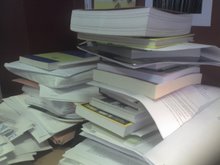
For the past month or so, Portico and Bad Idea Magazine have been running a writing competition. The prize, apart from various alcoholic inducements, is to be included in the first Bad Idea Anthology, which we are publishing later in the spring. The competition was to write a 1500 word piece on the subject of 'The Pen is Mightier than the Keyboard'. In front of me, I have a large stack of entries to read through by the end of the week -- on Friday, the editors of Bad Idea, hot literary agent Charlie Campbell and my good self, will retire to argue the toss about who deserves to win.
So far, the entries I have read have been the following: funny, touching, scary, terrible, wrong, right, unreadable and rewriteable. One entry came as a tracked document with all the changes and deleted sections. I'm guessing this was a mistake (either that, or an incredibly clever piece of postmodernism that was way too smart for me), though it was interesting to follow through the train of thought. Overall, though, I was touched at how many people were willing to enter and how much thought had been put in. Maybe it was the subject matter, but I found myself thinking about the process of writing a lot more than I was expecting. Which made for a very nice surprise.
Subscribe to:
Posts (Atom)