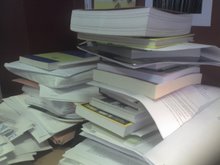
One of the most salutary lessons any editor or publisher can do is to spend a day treading the shop floors with a sales rep. Because it’s all very well negotiating with agents, commissioning books and working on the editorial nuances of the text, but unless you’ve got a clear idea of what it’s like out there at the coal face – till point? – all that hard work counts for nothing.
I used to be a bookseller many moons ago. When I first moved to London, back in the mid 1990s, I worked at Waterstone’s in Hampstead. The salary was south of £10,000, yet the shop was bursting full of bright and committed booksellers who had a real passion for books. This was in the days when booksellers had responsibility for their own sections and when ‘scale-outs’ of titles chosen by head office was only just beginning. It was a fun place – and a fun time to work. And in terms of publishing, I always think that sort of experience gives you an edge over those who have come in to the business straight from finishing their English Literature degree.
Today it’s all different. The bookshops are being squeezed on both sides: on range by Amazon and the Internet sellers; on price by the supermarkets. It’s all a bit grim. Times have been ‘tough’ on the high street for as long as I can remember. Which is not great, when you’ve got a new list of books to sell in.
Thursday, 24 May 2007


Tuesday, 15 May 2007
‘I thought I’d send you the whole manuscript anyway’
Another tip for sending in a submission to a publisher – send in what they ask for. Everyone has their own guidelines: find out what they are and follow them. Personally, I like a decent synopsis and a couple of sample chapters. That way, I can see if the book has legs, and whether the writer can actually write. If it’s good, I’ll ask for more. But not before. Writers who ignore such requests and send in the whole thing anyway I don’t tend to look favourably on. It’s a waste of the editor’s time. And more importantly, it’s a waste of trees.
Conversely, I’m not a huge fan of those writers who fire out emails with half a dozen book ideas, each a couple of lines long, and then expect a full length critique on the merits of each one. Not so much full of ideas as full of it. I say: come back when you’ve done some work.
Conversely, I’m not a huge fan of those writers who fire out emails with half a dozen book ideas, each a couple of lines long, and then expect a full length critique on the merits of each one. Not so much full of ideas as full of it. I say: come back when you’ve done some work.
Friday, 27 April 2007
A Different Kind of Delivery
On Wednesday morning, a beautiful little manuscript called Josephine arrived. As with many of my authors, she completely missed her delivery date, but when she finally appeared, it was more than worth the wait.
Friday, 20 April 2007
‘I know you don’t publish fiction, but …’
Here’s a tip if you’re approaching a publisher with a manuscript. Have a look first at the sort of books they publish. My website might not be the most comprehensive available on the web but it is fairly clear in the five categories of non-fiction I’m looking to buy books in. But even that is not enough to stop the constant stream of fiction, poetry, children’s books and illustrated titles that still come my way. If you start a letter with the sentence ‘I know you don’t publish fiction, but I really think you should look at my novel’, what sort of response are you seriously expecting? ‘Thank you so much for sending in your manuscript: as a result of the brilliance of your prose, I have decided to completely revisit my publishing plan, and shape it entirely round your future Booker Prize winning career…’
Wednesday, 18 April 2007
All the Fun of the Fair
To the London Book Fair, or LBF, or Load of Bloody Fuss, at Earl’s Court. It’s a sort of Ideal Homes Exhibition for publishers, and to be honest, I much prefer the venue when there’s a decent band on. In the olden days (ie. about ten years ago), the fair was an exciting place to be, with publishers running around like headless chickens throwing silly money at Big Books. These days, the only Big Book activity is the staged announcement that one has been bought weeks before, and the rights director trying to claw some of the advance back by selling foreign rights. For an editor now, it’s more about the meet and greet, catching up with old acquaintances and making new ones.
I am shown enough books on the environment to turn me into Jeremy Clarkson. An equal number of misery memoirs, not to mention stories of drug addicts and drug mules, alcoholics and prostitutes, all telling the ups and downs of their ‘rollercoaster’ life story, ‘overcoming’ their terrible odds. I’m offered an autobiography of an ex-boy band member, and another of one of the worst pop acts of recent years. I come away with the sense that I’ve only put my foot in it twice – once when I start talking to an editor about a friend’s wedding he hasn’t been invited to; and once when I big up a book I’m publishing in the summer to someone I then discover to be the author’s ex-wife. Ah well.
On day one of three I chat to seven literary agents, four American publishers, one Canadian publisher, three British editors, one television producer, one journalist and one professor. Oh, and to one author – a chap called Dave Cornthwaite who we have just signed up to tell his story of skateboarding from one side of Australia to another. He’s a nice guy and genuinely excited to be published. His enthusiasm is the highlight of my day.
I am shown enough books on the environment to turn me into Jeremy Clarkson. An equal number of misery memoirs, not to mention stories of drug addicts and drug mules, alcoholics and prostitutes, all telling the ups and downs of their ‘rollercoaster’ life story, ‘overcoming’ their terrible odds. I’m offered an autobiography of an ex-boy band member, and another of one of the worst pop acts of recent years. I come away with the sense that I’ve only put my foot in it twice – once when I start talking to an editor about a friend’s wedding he hasn’t been invited to; and once when I big up a book I’m publishing in the summer to someone I then discover to be the author’s ex-wife. Ah well.
On day one of three I chat to seven literary agents, four American publishers, one Canadian publisher, three British editors, one television producer, one journalist and one professor. Oh, and to one author – a chap called Dave Cornthwaite who we have just signed up to tell his story of skateboarding from one side of Australia to another. He’s a nice guy and genuinely excited to be published. His enthusiasm is the highlight of my day.
Publishing Words That Should Be Banned No. 1
Babylon – Books about Babylon itself are fine, but otherwise, please, enough already. Attaching Babylon to any subject – Gardening Babylon, Haberdashery Babylon, Cutting Your Toenails Babylon – is shameless shorthand to highlight the shameless approach to a given subject. It’s saying, you might think this subject is as dull as dishwater, but wait until we reveal the non-stop shagging and debauchery and vicious backstabbing that lies behind being a librarian!
Tuesday, 17 April 2007
An Editor is Like A Record Producer
On my first day as Publisher of Portico Books, I managed to pull off having a meeting with a rock star. If you ever get a chance when starting a new job, I’d recommend it. Far better than the tour round the office as you forget everyone’s name or sitting at your new desk pretending to look busy and important.
I’d even succeeded with the golden rule of potential author meetings – always bag the last one of the day as a. this is when the author will be at their most relaxed and b. as you’re at the end he’s more likely to remember you. Having the meeting at six meant the meeting was facilitated by beer and wine rather than tea and coffee. It also meant the meeting could run on – and run on it did. Six became seven, became eight, became nine, with the rock star (let’s call him Rock) holding fascinating forth. Rock also slept in the following morning, missing his meetings with the other publishers he was meant to see. As you can imagine, I wasn’t over-gutted about that.
The point of bringing all this up is not to suggest that an editor’s life is all about meeting rock stars – far from it, as days two to the present of being a publisher of Portico will confirm. Instead, it’s because of an analogy I made to Rock about what being an editor is all about – which according to the agent, struck home with Rock.
The relationship between an editor and a writer, I’d suggested, is like that between a record producer and a rock star. It’s the writer/ rock star’s role to come up with the creative magic, and the editor/ producer to shape it, to edit it and to rein in as appropriate. The best music is the stuff where a decent producer has been able to keep control of proceedings, and producing a book is no different. Once a rock star decides to self-produce their work, quality control normally goes out of the window. The more cynical might consider this editor’s unedited ramblings further proof of this point.
Rock liked the record producer analogy. This week the agent sent through the material he’s been writing. It’s like Rock – arresting, uncompromising, and downright great. Here’s hoping I’m the one let loose behind the mixing desk.
I’d even succeeded with the golden rule of potential author meetings – always bag the last one of the day as a. this is when the author will be at their most relaxed and b. as you’re at the end he’s more likely to remember you. Having the meeting at six meant the meeting was facilitated by beer and wine rather than tea and coffee. It also meant the meeting could run on – and run on it did. Six became seven, became eight, became nine, with the rock star (let’s call him Rock) holding fascinating forth. Rock also slept in the following morning, missing his meetings with the other publishers he was meant to see. As you can imagine, I wasn’t over-gutted about that.
The point of bringing all this up is not to suggest that an editor’s life is all about meeting rock stars – far from it, as days two to the present of being a publisher of Portico will confirm. Instead, it’s because of an analogy I made to Rock about what being an editor is all about – which according to the agent, struck home with Rock.
The relationship between an editor and a writer, I’d suggested, is like that between a record producer and a rock star. It’s the writer/ rock star’s role to come up with the creative magic, and the editor/ producer to shape it, to edit it and to rein in as appropriate. The best music is the stuff where a decent producer has been able to keep control of proceedings, and producing a book is no different. Once a rock star decides to self-produce their work, quality control normally goes out of the window. The more cynical might consider this editor’s unedited ramblings further proof of this point.
Rock liked the record producer analogy. This week the agent sent through the material he’s been writing. It’s like Rock – arresting, uncompromising, and downright great. Here’s hoping I’m the one let loose behind the mixing desk.
Subscribe to:
Posts (Atom)